

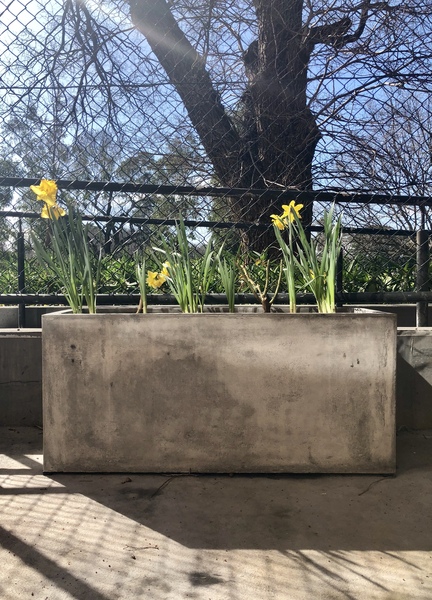
Picture this: it’s a Saturday morning in early October, the spring sun is doing its thing, you’ve got a flat white in hand, and the back deck is… a bit sad. A strip of concrete, a tired pot of rosemary, and some ambitions that never quite made it off the garden centre wish list. Sound familiar? You’re not alone. Millions of Australians have the outdoor space, the desire, and the green thumb — but haven’t yet discovered the single simplest upgrade that transforms any garden, patio, balcony, or courtyard: a great set of planter boxes.
Whether you’re gardening on a compact apartment balcony in inner Melbourne, a sun-baked courtyard in Perth, or a sprawling backyard on the Sunshine Coast, a thoughtfully chosen planter boxes garden setup can completely reimagine your outdoor living space. From growing your own vegies and herbs through to curating gorgeous floral displays or anchoring a design-led entertaining area, planter boxes are the workhorse of the modern Australian garden.
In this guide — fully updated for 2026 — we walk you through everything you need to know: what planter boxes actually are and why they work so brilliantly, the best types of plants for Australian conditions, how to choose materials that can handle our famously punishing climate, and expert maintenance tips tuned to every season from Darwin’s Dry to Hobart’s frost. We’ve also rounded up the Outdoor Emporium range so you can find the perfect fit for your space.
1. What Are Planter Boxes Garden and What Purpose Do They Serve?
At their core, planter boxes are contained growing vessels — typically rectangular or square — designed to hold soil and plants outside of the ground. They’re different from round pots or bowls in their architectural shape, which lends itself to structured garden design, edging, dividing spaces, and creating defined planting zones. You’ll find them on balconies, along fences, flanking driveways, lining pathways, on deck edges, and at front entrances across Australian homes.
The defining appeal of a planter boxes garden setup is control. Unlike in-ground planting, planter boxes let you manage your soil composition independently, move plants with the seasons, and create a garden in spaces that technically have no garden at all — like concrete patios or rooftop terraces. They’re also a brilliant solution for renters who can’t permanently alter a property, as well as homeowners who want to protect their plants from encroaching tree roots or particularly poor native soils.
Common Uses for Planter Boxes in Australian Gardens
- Vegetable and herb growing — raised off the ground for easier access, better drainage, and more control over soil quality.
- Privacy screening — tall planters filled with dense ornamental grasses or clumping bamboo create living green screens on exposed decks and balconies.
- Garden zoning — defining entertaining zones, pathways, and lawn edges without hard landscaping.
- Front entry styling — a matched pair of planter boxes flanking a front door creates instant kerb appeal.
- Native habitat and pollinator gardens — cluster several planters with Australian native species to attract honeyeaters, bees, and butterflies.
- Water-wise gardening — deep planters with quality potting mix actually retain moisture more efficiently than shallow in-ground beds, particularly during summer water restrictions.
| 🇦🇺 Australian context: Planter boxes are particularly valuable in newer suburban developments where topsoil depth can be shallow and soil quality poor after construction. Filling your own planter box with premium potting mix bypasses this challenge entirely. |
Whether you’re in a compact city terrace, a coastal home exposed to salt spray, or an inland property with clay-heavy soil, garden planter boxes offer a flexible, practical, and beautiful solution.
2. Benefits of Using Planter Boxes in Your Garden
The popularity of outdoor planter boxes across Australia has surged in recent years — and it’s easy to see why. Beyond aesthetics, there are real, practical advantages that make planter boxes one of the most versatile investments in any Australian garden.
| Better Soil Control Fill with exactly the right mix for your plants — no compromises with clay, sandstone, or rocky native subsoil. | Improved Drainage Well-designed planters with drainage holes prevent waterlogging, a common issue in heavy clay soils across coastal areas. | Pest Management Raising plants off the ground reduces slug, snail, and ground-level pest damage — a real win for vegetable growers. |
| Accessibility Raised garden planter boxes reduce bending and kneeling — ideal for older gardeners or those with mobility considerations. | Versatile Placement Concrete balcony? Paved courtyard? Flat rooftop? Planter boxes grow anywhere with adequate light. | Instant Aesthetics A pair of well-chosen planters can transform the look of an outdoor space as dramatically as any new furniture piece. |
There’s also the water-efficiency argument — a critical one in drought-prone Australia. A quality potting mix in a deep planter box holds moisture more effectively than shallow in-ground beds, and it’s much easier to apply mulch over a contained area, reducing evaporation. During your local council’s water restriction periods, this matters a lot.
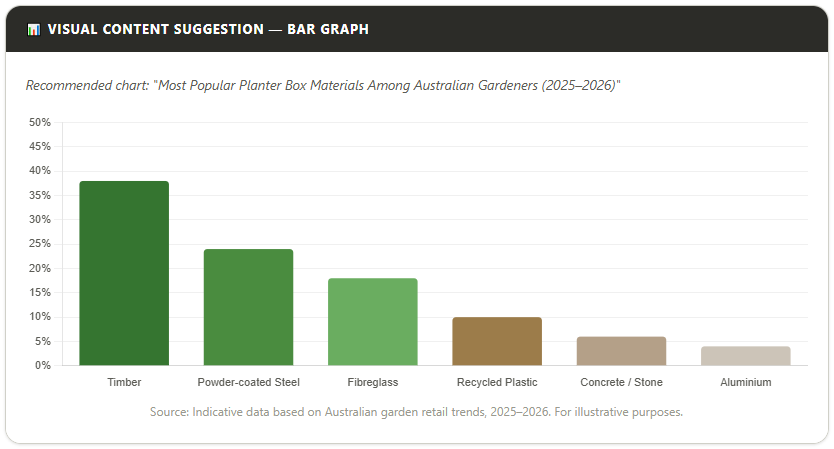
Timber remains the perennial favourite for Australian gardeners — it blends naturally with outdoor environments, provides insulation for root systems, and is widely available. However, powder-coated steel is rapidly gaining ground, particularly in contemporary and coastal homes where its clean lines and weather resistance are highly valued. Browse our range of timber planter boxes and steel and metal planter boxes to compare options.
3. Best Types of Plants That Thrive in Planter Boxes
One of the most common questions Australians ask when setting up a planter boxes garden is simply: “What should I actually grow in them?” The good news is that the list is impressively long — but success comes down to matching the right plant to your climate zone, planter depth, and sun exposure.
Australia spans six distinct climate zones — tropical, subtropical, Mediterranean, temperate, semi-arid, and alpine — and plant selection should always factor in your local conditions. Here’s a practical guide to what thrives in planter boxes across the country.
| Plant Type | Examples | Climate Zones | Min. Depth |
|---|---|---|---|
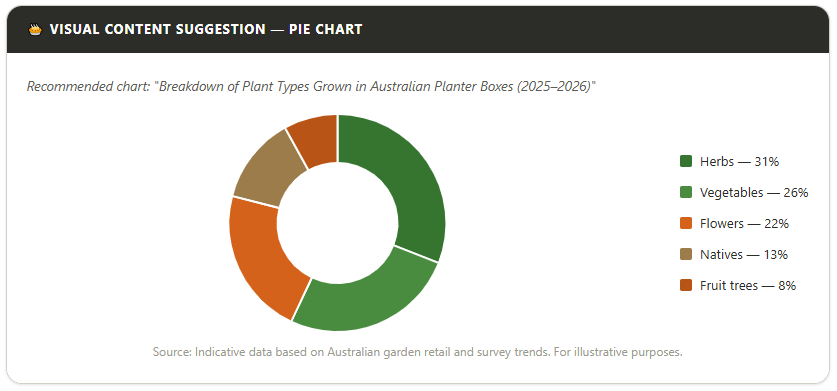
| Herbs | Basil, rosemary, chives, parsley, mint, thyme, oregano | All zones | 20–25 cm |
| Vegetables | Cherry tomatoes, silverbeet, zucchini, lettuce, capsicum, Asian greens, spring onions | Subtropical, Mediterranean, Temperate | 30–45 cm |
| Australian Natives | Dwarf Grevillea, pigface (Carpobrotus), lemon myrtle, Westringia, Brachyscome | All zones (species-dependent) | 25–40 cm |
| Flowers & Ornamentals | Petunias, marigolds, lavender, geraniums, succulents, impatiens | All zones (seasonal selection) | 20–30 cm |
| Dwarf Fruit Trees | Dwarf lemon, cumquat, dwarf lime, strawberries | Subtropical, Mediterranean, Temperate | 45–60 cm |
Climate-Specific Plant Picks for Australian Gardeners
Tropical and subtropical zones (QLD, NT, Northern WA): Herbs like lemongrass and Vietnamese mint absolutely thrive in the heat and humidity. Native Brachychiton and Pandanus palm varieties can make spectacular statement planters. Go for chilli, eggplant, and sweet potato in larger vegetable planters.
Mediterranean zones (Southern WA, Adelaide hills, parts of coastal SA): This is lavender, rosemary, and olive territory. Succulents and agaves do brilliantly in terracotta-coloured powder-coated planters. Mediterranean herbs like sage and marjoram flourish in long, sunny planter boxes against a north-facing wall.
Temperate zones (VIC, TAS, ACT, Southern NSW): The four-season growing calendar makes temperate Australia a veggie-grower’s paradise. Leafy greens, brassicas, root vegetables, and strawberries all perform beautifully. In cooler months, pansies, violas, and snapdragons add colour to ornamental planters.
Aussie Tip
When growing natives in planter boxes, avoid high-phosphorus fertilisers — most Australian native plants have evolved in low-phosphorus soils and can be damaged by standard “complete” fertilisers. Use a native-specific slow-release fertiliser or a liquid seaweed solution instead.
4. How Planter Boxes Elevate Your Garden’s Aesthetic and Design
There’s a reason landscape designers and garden stylists across Australia reach for planter boxes again and again — they’re one of the few garden elements that works both architecturally and organically. The right planter doesn’t just hold a plant; it anchors a visual composition, adds texture and height variation, and pulls a whole outdoor space together.
Styling Approaches for Australian Outdoor Spaces
Contemporary / Coastal: Pair powder-coated steel or aluminium planter boxes in anthracite grey or matte white with sculptural natives — think Agave attenuata, Anigozanthos (kangaroo paw), or coastal rosemary. The clean geometry of a steel planter box alongside natural plant forms creates a beautifully balanced contrast that suits the modern Australian home.
Relaxed Hamptons / Coastal White: White or cream timber planter boxes with classic plant selections — lavender, standard roses, or clipped box hedges — deliver that effortless coastal style. Line them along a painted picket fence or deck railing for maximum impact.
Tropical Lush: For a north Queensland–inspired feel, large, deep planter boxes planted with bird of paradise (Strelitzia reginae), elephant ears (Colocasia), or heliconia create dramatic, resort-like drama. Choose natural timber or wicker-effect fibreglass planters in warm tones to complement the tropical palette.
Native / Bushland Contemporary: Rough-hewn timber, raw steel Corten, or concrete-look planters filled with low-water natives — spinifex grasses, lomandra, and dwarf Banksia — suit the natural bushland aesthetic that’s increasingly popular in new Australian builds.
Design Principles for Arranging Planter Boxes
- Height variation — stagger planter heights to create depth and visual interest. A tall narrow planter behind a lower wide one creates a layered effect that mimics a natural garden.
- Odd numbers — groupings of three or five planters almost always look more dynamic and natural than pairs or fours (which can feel overly symmetrical unless the setting is formal).
- Repeat the palette — choose planters in one or two complementary materials and stick to them. Mixing too many finishes (timber + terracotta + bright blue fibreglass) can read as cluttered rather than curated.
- Consider the vertical plane — planter boxes along a fence line draw the eye up to the fence, wall, or screen behind them. Use trailing plants like dichondra or creeping thyme to soften planter edges downward, while upright grasses and feature plants lead the eye upward.
5. Tips for Maintaining Your Planter Boxes
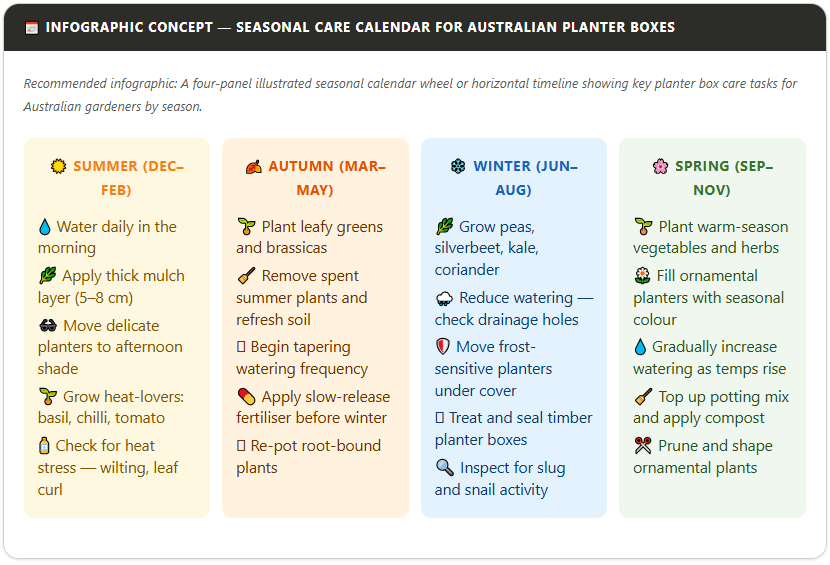
A planter boxes garden is delightfully low-effort compared to traditional in-ground beds — but it does need regular attention, particularly through Australia’s more extreme seasons. Here’s what to stay on top of, broken down by the four seasons.
General Maintenance Best Practices
Watering: Planter boxes dry out faster than in-ground beds because of their contained volume and air exposure on all sides. In summer, most planter boxes in sunny Australian spots need daily watering — ideally in the morning before heat builds. Self-watering planter inserts or drip irrigation systems connected to a timer are worth every cent if you’re going through a hot stretch.
Soil and fertilising: Potting mix breaks down over time. Top-dress your planters each spring with a fresh layer of quality potting mix (look for the red-tick premium grade from Standards Australia) and a slow-release fertiliser appropriate to what you’re growing. Replace potting mix entirely every 2–3 years to prevent compaction and nutrient depletion.
Drainage maintenance: Check drainage holes regularly — they can become blocked by root growth or compacted soil. A blocked planter is one of the most common causes of plant death. Raise planters slightly off hard surfaces using feet or castors to allow free drainage and prevent waterlogging.
Timber planter box care: Untreated timber will deteriorate faster than any other material in Australia’s UV-intense climate. Apply a quality exterior timber oil or water-based sealant to all external surfaces every 12–18 months. If you’ve got an old timber planter box showing surface greying, a light sand followed by a fresh coat of oil will bring it back to life.
Steel and powder-coated planter care: Check periodically for chips or scratches in the coating — touch up immediately with matching outdoor enamel spray paint to prevent rust from establishing. For coastal gardens exposed to salt air, give metal planters a rinse with fresh water every few weeks and dry off any moisture from joints.
| Australian Summer Warning Dark-coloured planter boxes (especially dark steel) can heat up dramatically in direct summer sun — potentially cooking roots even while soil moisture looks adequate. In tropical and arid zones, choose lighter colours, wrap planters in hessian during heatwaves, or position them where afternoon shade provides relief. |
6. Why Choose Outdoor Emporium for Your Planter Boxes?
When it comes to finding the right planter boxes for your Australian garden, the options out there can be pretty overwhelming — from cheap imports that warp in their first summer to premium pieces that genuinely last decades. At Outdoor Emporium, we’ve curated a range that takes the guesswork out of it.
What Sets Outdoor Emporium Apart
- Australian climate tested: Our planter box range has been specifically selected and stress-tested for Australian conditions — UV resistance, heat stability, and weather durability all come standard. We’re not just selling you a box; we’re helping you build a garden that survives the Aussie summer.
- Range breadth: From compact 60 cm herb planters for balconies to substantial 1.8-metre raised garden beds for serious veggie growing, the Outdoor Emporium range covers every scale of Australian garden. Choose from timber planter boxes, powder-coated steel, fibreglass, and more.
- Design-led selection: We stock planters that look as good as they perform — from clean contemporary steel in matte finishes to beautifully grained hardwood in natural and stained finishes that complement both traditional and modern Australian homes.
- Genuine expert advice: Our team are real gardening enthusiasts who can help you match the right planter to your space, climate, and plant ambitions. Not just order fulfilment — actual knowledge. Browse our blog and explore the full planter boxes range for guided selections.
- Australia-wide delivery: We deliver across Australia — metro and regional — with careful packaging to ensure your planter boxes arrive in perfect condition.
- Value for money: Our pricing reflects genuine quality — you won’t find us selling budget products at premium prices. Every planter box in our range earns its spot through durability, design, and honest value.
Conclusion: Create Your Perfect Planter Boxes Garden
Key Takeaways
- A thoughtfully chosen planter boxes garden setup can transform any Australian outdoor space — from a compact balcony to an expansive backyard.
- Choose materials suited to your climate: timber for natural warmth, powder-coated steel for durability, fibreglass for lightweight versatility.
- Match your plant selection to your climate zone — Australian natives, herbs, vegetables, and ornamentals all thrive in well-maintained planter boxes.
- Seasonal maintenance is key — Australian summers demand daily watering, mulching, and heat management; winter is for soil refreshing and structural upkeep.
- Outdoor Emporium stocks a full range of quality garden planter boxes designed to perform in Australian conditions.
There’s a real joy in a well-planted planter box — whether it’s the first snip of fresh basil from your balcony herb garden or the way a line of timber planters transforms a bare timber deck into something genuinely beautiful. The best part? You don’t need a huge budget, a landscaper, or a green thumb PhD to get started. You just need the right planter, decent potting mix, a plant or two that suits your spot, and a little bit of Australian persistence.
Outdoor Emporium is here to help you every step of the way — from choosing the right planter box to finding the plants and accessories to make it sing. Head to the shop, pick your favourite, and let’s get growing.