
Balcony planters are one of the fastest and most effective ways to transform a bare outdoor space into something genuinely beautiful. Whether you live in a Melbourne apartment, a Sydney terrace, or a Brisbane high-rise, the right outdoor planters make a dramatic difference. Choosing well matters. Material, sizing, drainage, weight, and plant compatibility all influence long-term results. This guide covers everything you need to know before buying — from selecting the correct planter box dimensions to understanding which plants perform best in Australian conditions.
Australian balconies face real challenges. Intense summer sun, coastal winds, sudden downpours, and strict building load limits all narrow your options. Fortunately, the planter market has evolved significantly. Today’s outdoor garden pots combine genuine durability with design quality that suits both contemporary apartments and heritage-style homes.
| Verified Fact According to the Australian Bureau of Statistics (ABS), apartment dwellings now account for approximately 16% of all occupied private dwellings across Australia — and that share continues growing in capital cities. Balcony planters represent one of the primary ways apartment residents create meaningful outdoor greenery. |
Why Balcony Planters Are Worth the Investment
Green outdoor spaces improve wellbeing. Research published by the Australian Government Department of Health consistently links access to nature and greenery with reduced stress levels and improved mood. Container gardening on balconies delivers those benefits without requiring a ground-level garden.
Beyond wellbeing, outdoor plant pots genuinely add property value. Real estate professionals across Melbourne, Sydney, and Brisbane note that styled balcony spaces photograph better and attract stronger buyer interest. A thoughtfully arranged balcony with quality garden planters signals that the property has been maintained with care.
Practically speaking, container gardening solves a real problem for renters and apartment owners alike. You can grow food, herbs, flowering plants, and natives without touching soil. Planter boxes, in particular, offer enough volume for root systems that need room to establish properly.
| 16% of Australian dwellings are apartments (ABS, 2021 Census) |
| 74% of Australians say outdoor space improves home satisfaction (CSIRO Liveable Housing research) |
| $2B+ Australian garden and outdoor products market annual value (IBIS World, approximate) |
| Data Note: Statistics above are drawn from publicly available Australian research data current as of mid-2026. Market valuation figures are approximate and sourced from IBIS World industry reports. Always verify current figures with the original source for commercial purposes. |
Importantly, container gardening using outdoor pots and planter boxes gives you complete control. You choose the soil quality, the fertiliser schedule, and the positioning. Moving a pot to catch morning sun or shelter from afternoon heat takes minutes. That flexibility is simply impossible with in-ground planting.
Planter Materials: Which One Suits Your Space?
Material selection is arguably the single most important decision when buying balcony planters. The wrong material fails quickly under Australian UV exposure, temperature swings, and coastal salt air. The right material lasts decades. Here is a clear breakdown of the main options available on the Australian market today.
| Fibreglass • Extremely lightweight • UV and fade resistant • Durable in coastal climates • Suitable for most balcony weight limits • Wide range of finishes available • Excellent value for large planters Best for balconies |
| Polystone / QuarterLite • Stone-like appearance, fraction of the weight • Frost and UV resistant • Premium finish quality • Available in large and oversized formats • Suitable for residential and commercial use Best for design-led projects |
| Poly Terrazzo • Textured terrazzo-effect surface • Lightweight for its visual weight • Contemporary aesthetic appeal • Weather and stain resistant • Works well indoors and outdoors Best for contemporary styling |
| Terracotta • Natural, breathable material • Excellent for moisture regulation • Heavier than synthetic alternatives • Can crack in severe frost • Classic aesthetic suits heritage homes Best for garden aesthetics |
| Kiln-Fired Ceramic • Highly durable and dense • Beautiful glazed finishes • Significant weight — check load limits • Statement pieces for prominent positions • Long lifespan when cared for properly Best for statement planting |
| Corten / Rust Steel • Industrial and contemporary look • Develops natural weathered patina • Heavy — suitable for ground level • Excellent for long planter box formats • Not ideal for high-rise balconies Best for courtyards and ground level |
For most Australian apartment balconies, fibreglass and polystone materials offer the best combination of weight, durability, and design quality. Outdoor Emporium’s Balcony Planters range includes several options in these materials — including The Balcony Planter, designed specifically with Australian apartment conditions in mind.
| “Lightweight, durable, and weather-resistant planters are not a luxury on an Australian balcony — they are a practical necessity. The right material means less maintenance, safer load distribution, and better plant health long-term.” |
Drainage, Root Health, and Potting Basics
Drainage is non-negotiable. Without it, roots suffocate in waterlogged soil. This is the most common reason container plants fail — not sunlight, not watering frequency, but drainage failure. Every balcony planter you buy should have at least one drainage hole. Larger planter boxes benefit from multiple drainage points.
On balconies, drainage creates a secondary concern: runoff. Water must go somewhere after it exits the pot. Using saucers is common, but saucers that hold water indefinitely create exactly the same root rot risk you were trying to avoid. Choose self-draining saucers or use pot feet to elevate planters slightly, allowing air circulation under the base and controlled water exit.
Potting Mix Selection
Standard garden soil performs poorly in containers. It compacts quickly, drains badly, and becomes hydrophobic when it dries out completely. Premium Australian potting mixes are formulated specifically for container use. Look for the Australian Standards five-tick mark (AS 3743) on potting mix packaging—this confirms the mix meets strict quality requirements for container growing.
Adding perlite or coarse sand to premium potting mix improves drainage further. A drainage layer of gravel or coarse scoria at the pot base — roughly 3-5cm deep — prevents the drainage hole from clogging with fine potting mix over time.
| Verified Fact — Standards Australia Australian Standard AS 3743 sets minimum quality benchmarks for potting mixes sold in Australia. Products marked with the Standard Mark are independently tested for nutrient content, pH, particle size, and moisture-holding capacity. Source: Standards Australia |
Root Health in Deep Planter Boxes
Deep planter boxes — like the Euro Trough Tall or the XL Planter Box — offer sufficient root depth for shrubs and even small trees. However, deeper containers hold more moisture at the base. To manage this, plant taller-growing species in deep planters rather than shallow-rooted annuals. The root mass will better utilise the available soil volume and reduce waterlogging risk.
Regular checking of drainage holes is part of basic planter maintenance. Roots can block outlets over time. Lifting planters seasonally and clearing blocked drainage is a simple task that prevents significant plant loss.
Sizing Your Balcony Planters Correctly
Size selection comes down to three factors: available space, plant choice, and structural load capacity. Getting any one of these wrong creates problems that are difficult and expensive to fix after purchase.
Balcony Load Capacity
Australian building codes set minimum load requirements for balconies. Most residential balconies are engineered for 1.5 to 3.0 kPa (kiloPascals) of live load — roughly 150 to 300 kilograms per square metre. However, this figure includes people, furniture, and planters combined. Always consult a structural engineer or your building manager before placing multiple heavy planters on a balcony. Lightweight materials like fibreglass and polystone exist precisely to reduce this risk.
| Small Balcony (under 6m2) Use 40-65cm planter boxes. The Euro Trough 65 fits rail lengths well. Opt for lightweight materials. Limit to 2-4 planters maximum. |
| Medium Balcony (6-15m2) 80cm planter boxes and mid-size rounds work well. The Euro Trough 80 is purpose-built for this scale. Mix heights for layered effect. |
| Large Balcony or Terrace (15m2+) The Euro Trough 132 or Vermont Planter Boxes create strong visual anchors. Pair with Round and Cube planters for composition. |
| Courtyard or Ground-Level Full range opens up. The architectural Rust 2mtr Planter Box and Rust 2.4m Planter Box variations create dramatic linear borders. |
Styling Balcony Planters for Maximum Impact
Styling outdoor planters is not complicated, but it does require some intentional thought. The most common mistake is buying a collection of similarly sized, similarly shaped pots. The result looks cluttered and lacks visual hierarchy. Instead, use the principle of varied height, shape, and texture.
Creating Height Variation
Start with tall planters at the back or sides. The Tall Rounds QuarterLite or ShadowLine Cylinder planters anchor the space visually. Mid-height planter boxes go in the next zone. Small Planter Boxes Square or Cube planters work beautifully at the front. This layered structure makes a balcony feel considerably larger and more considered.
Mixing Shapes
Combine rectangular planter boxes along balcony edges with round outdoor pots clustered in corners. Rectangular planter boxes suit linear spaces like balcony rails and courtyard walls. Round and cylindrical pots break up hard lines and add softness. Square planter boxes bridge both worlds — structured but compact.
Colour and Finish Coordination
Contemporary Australian homes typically lean toward stone tones, charcoal, matte black, or warm concrete finishes. Outdoor Emporium’s QuarterLite range delivers exactly these aesthetics. The Soft Edge Cube Poly Terrazzo and Soft Edge Planterbox Poly Terrazzo bring textured surface interest without visual busyness. For homes with warmer or more traditional palettes, the Anduze Urn range — particularly the Striped Copper Sealed and Traditional Cream Glaze options — offers exceptional character.
Consistency matters more than uniformity. You do not need every pot to match exactly. However, choosing planters within a shared colour family or material type creates visual cohesion. Two or three different finishes within one neutral palette feels curated rather than accidental.
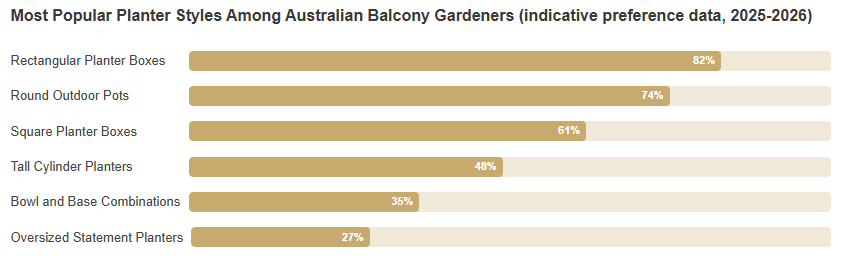
| Chart Note: Preference data is indicative and compiled from Australian garden retailer and online search trend data (Google Trends Australia, 2025-2026). Figures represent relative search and purchase interest rather than census-level statistics. |
Australian Weather, Wind, and Sun Considerations
Australian conditions test outdoor planters hard. UV radiation in Australia ranks among the highest in the world — ARPANSA confirms that Australia receives some of the highest UV levels globally due to proximity to the ozone hole and clear skies. This means cheaper plastic pots crack, fade, and become brittle within a single summer. Quality fibreglass and polystone planters are specifically UV-stabilised to resist this degradation.
Managing Wind on Balconies
Wind is the silent enemy of balcony gardens. It accelerates moisture loss from both soil and foliage. It physically damages tall, top-heavy plants. On upper-floor balconies in coastal cities, wind speeds can reach damaging levels even during mild weather events. Selecting stocky, wind-tolerant plants is essential. Equally important is choosing planters with sufficient weight — or enough base width — to resist toppling in gusts.
Heavier fibreglass planter boxes with wide bases, such as the Vermont Planter Boxes QuarterLite range, provide stability that lightweight round pots cannot. On very exposed balconies, securing planters to wall brackets or using weighted bases adds another layer of safety.
Managing Intense Sun
North and west-facing balconies receive the most intense afternoon sun. Dark-coloured outdoor garden pots absorb heat and can raise root zone temperatures to damaging levels. Lighter-coloured planter surfaces — stone tones, cream, pale grey — reflect heat more effectively. Alternatively, wrapping dark pots in hessian or positioning them behind taller plants creates natural insulation during peak heat hours.
| Verified Fact — ARPANSA Australia and New Zealand consistently record some of the world’s highest levels of UV radiation exposure. UV levels in Australia can be twice those experienced at similar latitudes in the Northern Hemisphere. This directly affects the lifespan of outdoor materials including plastics, paints, and unsealed timber. Source: Australian Radiation Protection and Nuclear Safety Agency (ARPANSA) |
Plant Selection for Australian Balconies
The best balcony garden starts with plants suited to the specific conditions of your space. Aspect, floor level, wind exposure, and available sunlight hours all determine what will thrive. Australian native plants have evolved for local conditions — many perform exceptionally well in container gardens on balconies.
Full Sun Balconies
North and west-facing balconies receiving 6+ hours of direct sun daily support a wide plant palette. Bougainvillea performs spectacularly in large planter boxes outdoor — trailing colour over balcony railings throughout warmer months. Geraniums, lavender, rosemary, thyme, and ornamental grasses are reliable performers. Dwarf citrus in a deep, wide garden planter box produces fruit beautifully even in containers.
Part Shade and Sheltered Balconies
East-facing balconies receiving morning sun and afternoon shade suit a different range. Ferns, peace lilies, impatiens, and shade-tolerant natives like Blechnum ferns or Asplenium work well. The Royal Botanic Gardens Victoria maintains excellent resources on selecting plants suited to shaded outdoor containers in Melbourne’s climate.
Wind-Resistant Plants for Exposed Balconies
Lomandra longifolia, Dianella species, Agave, and various succulents tolerate coastal wind exposure remarkably well. Their compact root systems also perform well in rectangular planter boxes where root spread is limited. Avoid tall, single-stemmed plants on exposed balconies — they snap or topple quickly in strong winds.
Food Growing on Balconies
Balcony food gardens are genuinely productive when managed well. Cherry tomatoes, herbs, silverbeet, lettuces, strawberries, and dwarf beans all perform in outdoor plant pots and planter boxes. Use deep planter boxes with minimum 30cm soil depth for most food crops. The Euro Trough 65 and Euro Trough 80 offer ideal dimensions for balcony herb gardens and salad leaf production.
For further plant selection guidance, the Wikipedia article on container gardening provides a useful overview of the principles involved — including soil requirements, fertilisation, and container sizing for different plant types.
Maintenance and Seasonal Care
Balcony planters require consistent but not complicated maintenance. Establishing a simple seasonal routine prevents the majority of problems before they develop.
Watering on Balconies
Containers dry out faster than garden beds. Wind and reflected heat from walls and glass accelerate moisture loss significantly. During peak Australian summer, outdoor plant pots in full sun may need watering daily. Self-watering inserts and water-retaining potting mixes reduce this frequency. Checking soil moisture by finger-testing 3-4cm below the surface is more reliable than calendar-based watering schedules.
Fertilising Container Plants
Potting mixes lose nutrients faster than garden soil due to leaching through drainage. Slow-release fertiliser granules at planting time, supplemented by liquid feeds every 4-6 weeks during the growing season, maintain consistent plant health. Organic liquid fertilisers work particularly well for edible plants in balcony garden containers.
Repotting and Refreshing
Most container plants benefit from repotting every 2-3 years. Root-bound plants show declining vigour, increased watering demand, and poor flowering. Moving plants into a planter box or pot one size larger — or fully refreshing the potting mix in the existing container — restores performance quickly.
Seasonal Cleaning of Planters
Cleaning outdoor pots annually prevents salt and mineral deposits from accumulating. Rinse thoroughly after winter. Inspect drainage holes each spring. Wipe exterior surfaces of fibreglass and polystone planters with mild soapy water to maintain their finish. Avoid abrasive cleaners on glazed or specialty finish surfaces like those on kiln-fired pieces from the Atlantis or Anduze Urn collections.
The Outdoor Emporium Range: What to Consider
Outdoor Emporium stocks one of Australia’s most comprehensive selections of premium outdoor pots, garden planters, and balcony planter boxes. The range spans materials, sizes, and styles to suit genuinely different project types — from apartment balconies to large residential gardens.
For Compact Balconies
The Euro Trough 65 remains a consistently popular choice for smaller balconies. Its rectangular form fits neatly against balcony walls or railings. Depth is sufficient for herbs, succulents, and shallow-rooted annuals. The Small Planter Boxes Square options work equally well for corners and rail positions.
Among the contemporary round options, the Short Rounds QuarterLite and Middle Rounds QuarterLite add organic contrast to linear balcony layouts without consuming excessive floor space.
For Medium to Large Balconies
The Euro Trough 80 and Euro Trough 132 scale beautifully on generous balcony or terrace spaces. Pairing these with the Tall Rounds QuarterLite creates the height variation necessary for a layered, garden-like feel. The Regulation Planter provides a robust option for those seeking a more architectural planting approach.
For Statement Positions
The Anduze Urn collection brings genuine heritage character to balconies with traditional or French-inspired styling. The Traditional Copper Rust and Striped Classic Stone finishes photograph exceptionally well and age gracefully in Australian outdoor conditions.
For those designing contemporary courtyards at ground level, the Rust 2mtr Planter Box and Rust 2.4m Planter Box in Corten steel create dramatic linear borders with minimal maintenance requirements once the weathering patina develops.
Wholesale and Commercial Requirements
Outdoor Emporium also supplies wholesale garden pots to landscape professionals, commercial property managers, strata buildings, and hospitality venues. The QuarterLite range suits commercial applications particularly well due to its consistent quality, predictable lead times, and range of sizes suited to professional planting schemes.